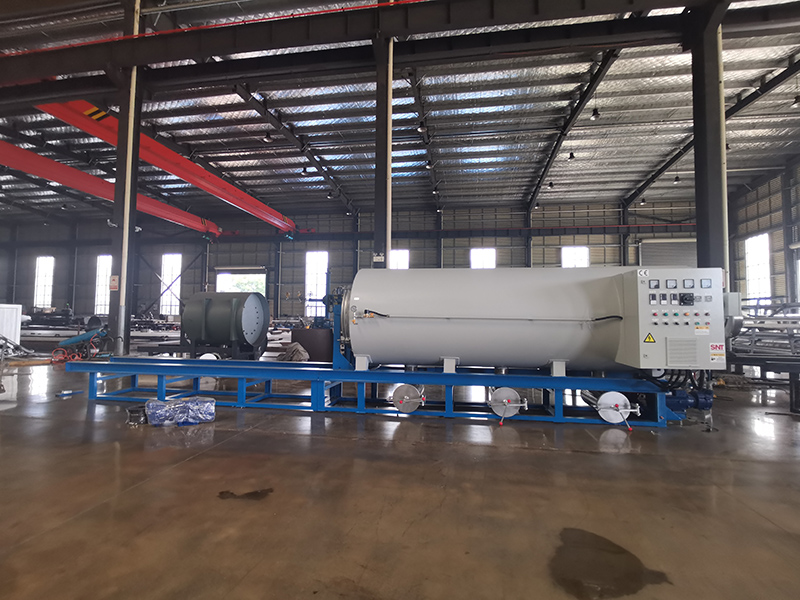
Screw Cleaning Furnace Automation: What to Look for When Buying
If you are running polymer processing lines or handling precision components like screws, spinnerets, and filter meshes, the cleaning furnace is not a “nice to have.” It is a bottleneck waiting to happen if it is not automated properly. The real question is not whether you need automation. It is how deep the automation goes and whether it actually protects your process or just looks good on a spec sheet.
Why Automation Is the Real Deciding Factor
Most buyers focus on temperature range, vacuum level, and chamber size. Those matter, but they are table stakes. The automation layer is what separates a furnace that delivers consistent results from one that depends on your best operator being in a good mood that day.
The Hidden Cost of Running Manual
Manual operation sounds cheap until you factor in what it actually costs. Every time someone has to adjust a temperature setpoint by hand, log a vacuum reading on paper, or decide when to break vacuum based on “feel,” you are introducing variance. In semiconductor and high-purity polymer applications, residue tolerance can be under 0.1 micrograms per square centimeter. That kind of precision does not survive human guessing.
Beyond quality, there is downtime. A single uncontrolled thermal cycle can warp screw components made from 4140 H.T. steel, which typically holds tolerances within 0.03 millimeters. One bad run and you are not just cleaning, you are replacing parts. Industry data suggests that unplanned equipment faults can cost between 100,000 and 500,000 yuan in lost output per day. Automation is not an expense. It is insurance.
Core Automation Features That Actually Matter
Not all “automated” furnaces are built the same. Some have a timer and call it a day. Others run a full logic chain that manages every phase of the clean. Here is what separates the two.
PLC Control with Multi-Stage Temperature Programming
A proper PLC-based control system should support at least three to five programmable temperature nodes. This means you can define a ramp-up curve, hold at a soak temperature, and then cool down in a controlled sequence, all without touching the machine. The advantage is not convenience. It is repeatability. When every batch follows the exact same thermal profile, your cleaning results become predictable, and your process becomes auditable.
Look for systems that allow recipe storage with permission controls. You want your senior technician to lock in a proven cleaning program so nobody accidentally overwrites it during a shift change. If the furnace only lets you set one temperature and hit start, it is not truly automated. It is a heater with a switch.
Safety Interlocks and Automatic Fault Response
This is where automation earns its keep. A well-designed furnace should have hard and soft interlocks on every critical point: door lock status, vacuum integrity, temperature overshoot, and cooling sequence. If the door opens mid-cycle, the system should halt immediately, not wait for someone to notice.
Temperature excursions above the setpoint should trigger automatic shutdown, not just an alarm that hopefully someone hears. Vacuum leaks should be detected in real time, with the system pausing the heat cycle until pressure stabilizes. These are not luxury features. In environments with flammable residues or reactive polymers, they are the difference between a controlled process and a safety incident.
Furnaces rated for hazardous environments should carry explosion-proof certifications and appropriate IP ratings. If your facility has dust, corrosive vapors, or high ambient temperatures, the automation system needs to survive those conditions too. A PLC that crashes because of heat or contamination defeats the entire purpose.
Evaluating Automation Quality Before You Commit
Ask the Right Questions, Not the Obvious Ones
Do not ask “does it have a PLC?” Every furnace on the market claims that. Instead, ask:
Can the recipe be edited without opening the control cabinet? Are alarm messages specific enough to pinpoint a fault in under five minutes? Does the system log every cycle’s temperature, vacuum, and duration automatically? Can you export that data for traceability?
The answers tell you whether the automation was designed for the operator or for the engineer who has to fix things at 2 AM.
Match Automation Depth to Your Actual Needs
A lab running small batches of screw components does not need the same automation level as a production line cleaning hundreds of spinnerets per day. For low-volume use, a basic programmable controller with a few preset curves may be enough. For high-throughput operations, especially in semiconductor or aerospace cleaning, you need full recipe management, real-time monitoring, remote diagnostics, and integration capability with your MES or SCADA system.
The mistake most buyers make is over-automating for a simple task or under-automating for a complex one. Both waste money. The right automation level is the one that makes your process stable, your data traceable, and your operators confident, without adding complexity they cannot maintain.