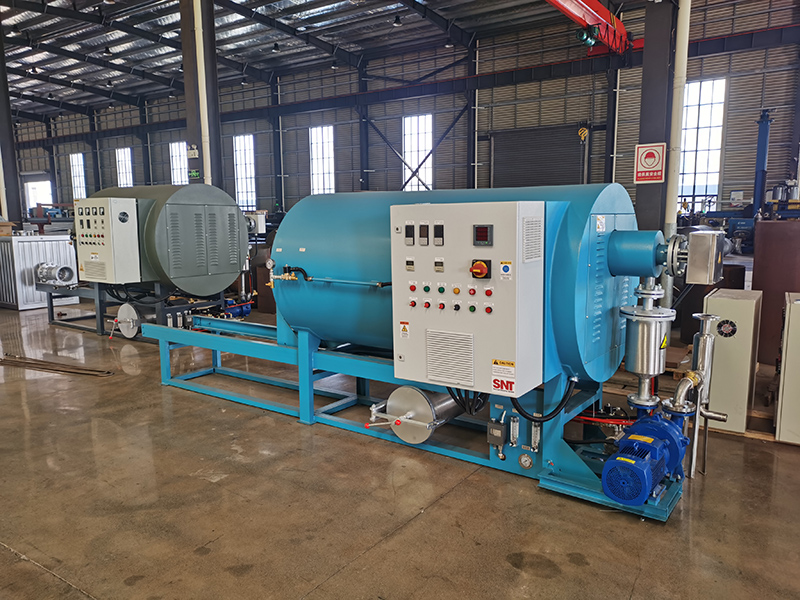
Screw Cleaning Furnace Selection by Production Capacity: The Only Guide You Need to Avoid Costly Mistakes
Buying the wrong screw cleaning furnace is not just an inconvenience — it is a financial disaster waiting to happen. Too small and you bottleneck your entire production line. Too large and you burn money on idle capacity every single day. The sweet spot exists, but finding it requires understanding exactly how production volume maps to machine specifications.
Most buyers make the same mistake: they pick a furnace based on what sounds impressive instead of what their actual daily throughput demands. This guide cuts through the noise and shows you how to match your real production numbers to the right equipment — no guesswork, no wasted budget.
Why Capacity Mismatch Is the Number One Reason Screw Cleaning Furnaces Fail to Deliver
Here is a truth nobody in the sales department will tell you: a furnace rated for 100 pieces per day will struggle — and eventually break down — if you feed it 150. Conversely, a furnace built for 200 pieces per day will sit half-empty and waste energy if you only need to process 80.
The mismatch creates two problems. First, mechanical stress. Pushing a furnace beyond its designed throughput means the heating elements cycle harder, the vacuum pump works overtime, and the temperature control system cannot keep up. Second, economic waste. An oversized furnace consumes the same baseline power whether it runs at 30% or 100% capacity. You are paying for performance you never use.
The fix is simple in concept but requires discipline in execution: match the chamber volume and heating capacity to your actual daily cleaning volume, not your aspirational volume.
Small-Scale Operations: Daily Throughput Under 50 Pieces
If your operation cleans fewer than 50 screw components, filter cores, or spinneret plates per day, you do not need an industrial-grade machine. A compact chamber in the 500-liter range is more than sufficient — and dramatically more cost-effective.
What to Prioritize at This Scale
At low volumes, temperature precision matters more than raw power. You are not racing against a production clock. You need consistent, repeatable results. Look for a furnace with temperature control accuracy of ±3°C or better. This ensures the polymer residues on your screws decompose uniformly without hot spots that leave carbon buildup behind.
Vacuum performance is equally critical. The vacuum degree should reach at least 10Pa, with pump-down time under 30 minutes. Why? Because at low volumes, every cleaning cycle is precious. If you spend 45 minutes just pulling vacuum before you can start heating, you are burning time and energy on nothing.
Automation Is Still Worth It — Even at Small Scale
Do not skip the PLC control system just because you are a small operation. A programmable logic controller with multi-stage heating profiles eliminates operator error entirely. You press one button, the furnace runs through preset temperature nodes, holds at each stage, and shuts down automatically. This removes roughly 80% of manual intervention — which at small scale means one operator can manage the furnace instead of three.
Mid-Scale Operations: Daily Throughput Between 50 and 100 Pieces
This is the most common production bracket, and it is also where most buying mistakes happen. A 500-liter furnace that worked fine at 30 pieces per day will choke at 80. You need to step up — but not all the way to the biggest machine on the market.
The 1000-Liter Sweet Spot
For daily volumes between 50 and 100 pieces, a 1000-liter chamber is the right balance. It provides enough internal volume to handle multiple screw assemblies or filter cores in a single cycle without overcrowding. Overcrowding is a silent killer — it blocks vacuum flow, creates uneven heating, and leaves residues in corners the heat cannot reach.
The temperature control precision should tighten to ±3°C, and the vacuum system should hit 10Pa or better. At this scale, you also want to pay attention to the heating element material. Furnaces using 310S stainless steel for the chamber interior resist corrosion and carbon buildup far better than standard steel. This means less downtime for manual scrubbing and longer intervals between deep cleans.
Why Multi-Stage Heating Changes Everything at This Scale
A single-stage heater ramps up to one temperature and stays there. That works for simple cleaning but fails when you are processing mixed materials — say, polyester screws one day and nylon filters the next. Different polymers decompose at different rates. A multi-stage programmable system lets you set 3 to 5 temperature nodes, each held for a specific duration. The result: cleaner parts, less energy waste, and no trial-and-error guesswork.
Large-Scale Operations: Daily Throughput Over 100 Pieces
When you are cleaning more than 100 pieces per day, you are no longer buying a furnace — you are buying a production system. The selection criteria shift dramatically.
Chamber Volume Must Scale With Throughput
At 100+ pieces per day, a 1000-liter furnace becomes a bottleneck. You need 1000 liters or larger, depending on the size of your components. For heavy-duty screws or large filter assemblies, custom chamber dimensions become necessary. The key rule: the chamber must accommodate your largest component with at least 15% clearance on all sides for airflow and vacuum circulation.
Vacuum Stability Is Non-Negotiable
At high throughput, vacuum fluctuation destroys cleaning quality. If the vacuum bounces between 5Pa and 20Pa during a cycle, some parts get fully cleaned while others get half-treated. For large-scale operations, the vacuum system must maintain stability within ±2Pa of the target. This typically requires a high-precision screw vacuum pump — not a basic rotary vane pump.
The pump-down time must stay under 30 minutes even at full chamber load. If it takes longer, your cycle time balloons and your effective throughput drops even though the furnace is physically large enough.
Automation Becomes Mandatory, Not Optional
At this scale, human intervention is not just inefficient — it is dangerous. High-temperature vacuum systems with manual control create risk every time an operator opens the chamber or adjusts a valve. A full PLC system with automatic temperature ramping, automatic slag discharge, automatic cooling sequence, and real-time monitoring of vacuum and temperature data is not a luxury. It is the minimum standard.
The system should also include automatic fault detection. If vacuum leaks or temperature spikes beyond the set range, the furnace should alarm and shut down without waiting for a human to notice. One unchecked fault at this scale can ruin an entire batch of components — and the replacement cost runs into serious money.
The Hidden Capacity Factor Nobody Talks About: Maintenance Intervals
Capacity selection is not just about what the furnace can do today. It is about what it can do consistently over years. And that depends entirely on maintenance design.
Vacuum Pump Service Intervals Define Real-World Uptime
A screw vacuum pump should have its oil changed every 500 hours of operation. Use ISO VG100 grade oil — nothing cheaper. Every 1000 hours, run a full airtightness test on the pump. If the vacuum degree has drifted more than 2Pa from the original spec, the pump needs servicing before it causes cleaning failures.
Furnaces that ignore this schedule see vacuum performance degrade over months. The parts look clean on the surface but have micro-residues in the threads and bore holes. You do not notice until the screws start clogging mid-production — and by then, you have already lost a day of output.
Heating Element Longevity Depends on Operating Load
Heating elements in an oversized furnace running at 40% capacity actually last longer than elements in a correctly sized furnace running at 90%. But the energy cost of that oversizing eats the savings. The optimal strategy: size the furnace correctly, then reduce element stress by using multi-stage heating instead of full-power continuous operation. This extends element life by 20 to 30% while keeping energy consumption in check.
How to Calculate Your Real Capacity Need — Not Your Imagined Need
Stop guessing. Sit down with your production logs for the last 30 days and calculate three numbers.
Average daily pieces cleaned. Not your best day. Not your worst day. The average.
Largest single component volume. Measure the biggest screw or filter core you put in the furnace. Multiply by 1.15 for clearance. That is your minimum chamber requirement.
Peak day volume. Find the highest daily number in your logs. Size your furnace for this number, not the average. A furnace that handles your peak day will coast on average days. A furnace sized for average days will fail on peak days.
Once you have these three numbers, match them to the chamber volume, vacuum performance, and heating capacity ranges outlined above. That is your selection. No sales pitch can override real data.
The Throughput-Energy Connection Most Buyers Ignore
Here is something that hits your bottom line harder than the purchase price: energy consumption per piece cleaned.
A properly sized furnace running at 80 to 90% of its rated capacity achieves the best energy-per-piece ratio. An undersized furnace running at 100% burns more energy per piece because it takes longer to complete each cycle. An oversized furnace running at 50% wastes baseline power on empty chamber volume.
Look for furnaces with thermal efficiency of 90% or higher. Multi-stage heating helps here — instead of blasting the entire chamber to 500°C and holding it there, the system ramps up gradually, holds only as long as needed at each stage, then cools down efficiently. This can reduce energy consumption by 20 to 30% compared to single-stage designs, which at 300 operating days per year translates into tens of thousands of dollars saved.
What Happens When You Get It Wrong — The Real Cost
Buying undersized creates a cascade. The furnace cannot keep up, so you run extra cycles. Extra cycles mean more energy, more pump wear, more element degradation. Within six months, you are spending more on repairs and lost production than you saved on the cheaper machine.
Buying oversized creates a different cascade. You paid for capacity you do not use. The idle power draw runs every single day. The larger chamber takes longer to pump down and heat up, which means each cycle is slower even though the furnace is physically bigger. You end up with lower effective throughput than a correctly sized smaller machine.
The right size is not the cheapest option and not the most impressive option. It is the one that matches your actual numbers — average volume, peak volume, largest component, and energy budget. Everything else is noise.