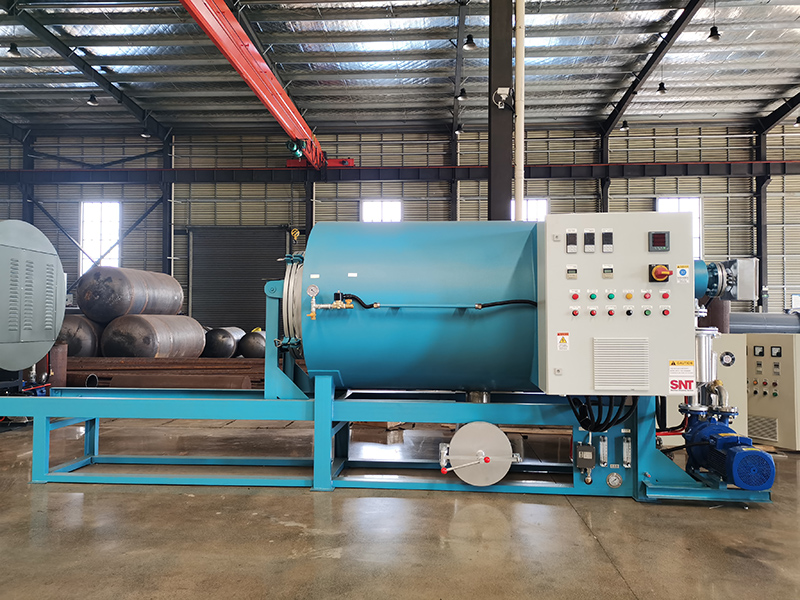
What You Absolutely Should Not Do When Operating a Screw Cleaning Furnace at High Temperature
Running a screw cleaning furnace at 450 degrees Celsius or higher is not the same as running it at 300. The physics change. The risks change. The things that seem harmless at low temperature become serious hazards when the heat climbs. Most operators learn these lessons the hard way, usually after a broken part, a failed pump, or a safety incident. This guide covers the mistakes that cause the most damage at high temperature, so you do not have to learn them yourself.
Never Introduce Cold Material Into a Hot Chamber
This is the single most common mistake at high temperature, and it is the most destructive.
Thermal Shock Cracks Everything It Touches
When a cold screw barrel drops into a chamber sitting at 450 degrees Celsius, the temperature differential can exceed 400 degrees in seconds. That shock wave travels through the barrel wall, the bore surface, and the flight roots. Micro-cracks form instantly. You cannot see them with the naked eye, but they are there. Over 50 cycles, those cracks propagate and the barrel fails in production.
The same shock hits the chamber walls, the door seal, and the quartz fixtures. Repeated thermal shock degrades all of them faster than normal aging would. A furnace that should last 10 years can die in 3 if you keep dropping cold parts into a hot chamber.
Pre-Heat Barrels Before Loading at High Temperature
If you are running a cycle above 400 degrees Celsius, pre-heat your barrels to at least 150 degrees Celsius before loading. A simple pre-bake station or even a warm room works. This reduces the thermal differential to under 300 degrees, which the barrel can absorb without cracking. It adds 15 minutes to your prep time. It saves you from replacing barrels every few months.
Never Mix Incompatible Polymers in a High-Temperature Cycle
At lower temperatures, mixing residue types is annoying. At high temperatures, it is dangerous.
PVC and Fluoropolymers Create Toxic Gas at High Heat
If a barrel that ran PVC goes into the same cycle as a barrel that ran PE, the PVC residue decomposes into hydrochloric acid gas above 300 degrees Celsius. At 450 degrees Celsius, that acid forms fast and in large quantities. It attacks the chamber lining, corrodes heating elements, and ruins every barrel in the load. The damage is not visible until the next batch comes out with pitted surfaces and discolored bores.
Fluoropolymers like PTFE or PVDF are even worse. They release fluorine-based gases at high temperature that eat through stainless steel chamber walls. One bad mix can cost you a full chamber refurbishment that runs into tens of thousands.
Always Clean the Chamber Between Different Polymer Types
If you switch from one polymer to another, do a blank cycle first. Run the chamber empty at high temperature for 30 minutes to burn off any residual gas from the previous load. Then wipe the chamber down before loading the next batch. This takes 45 minutes. It prevents catastrophic damage that takes weeks to repair.
Never Exceed the Rated Temperature Without Checking the Barrel First
The furnace might be rated for 600 degrees Celsius. Your barrel might not be.
Barrel Metallurgy Has Limits You Cannot See
Most screw barrels are made from nitrided steel or bimetallic alloys. These materials handle high temperature well, but they have a ceiling. Push past 500 degrees Celsius on a barrel that was only rated for 450, and the nitride layer starts to break down. The bore surface softens. The flight roots lose their hardness. You will not notice until the barrel starts wearing out in production three weeks later.
Check the barrel manufacturer’s temperature rating before every high-temperature cycle. If you do not have that data, assume the limit is 450 degrees Celsius and do not go above it. It is safer to under-clean a barrel than to destroy it.
Heating Elements Degrade Faster at Maximum Temperature
Running at peak temperature every cycle shortens element life dramatically. Elements rated for 600 degrees Celsius will last 2,000 hours at 450 degrees but only 800 hours at 600. The difference is not linear. It is exponential. Every 25 degrees above the recommended operating temperature cuts element life by roughly 30 percent. If you do not need to run at maximum temperature, do not. Your maintenance budget will thank you.
Never Ignore Vacuum Stability at High Temperature
Vacuum behavior changes completely when the chamber is above 400 degrees Celsius. What holds vacuum at 300 degrees will not hold it at 450.
Outgassing Accelerates Nonlinearly Above 400 Degrees
Every surface inside the chamber releases trapped gas when heated. At 300 degrees, this is manageable. At 450 degrees, the outgassing rate can triple. If your vacuum pump is sized for 300-degree operation, it will struggle at 450. The chamber pressure will creep up, oxygen will get in, and your clean barrel will oxidize before the cycle finishes.
Size your pump for the highest temperature you plan to run, not the average. A pump that handles 10 Pascals at 300 degrees might only hold 50 Pascals at 450. That difference is the difference between a clean barrel and a ruined one.
Micro-Leaks Become Major Problems at High Temperature
A tiny leak that you never notice at 300 degrees becomes a serious vacuum loss at 450. The higher temperature increases the pressure differential across the seal, which forces more air through any imperfection. Check your door gasket, chamber seals, and vacuum fittings before every high-temperature cycle. Replace any gasket that shows compression set or cracking. A gasket that costs 50 dollars saves you a 5,000 dollar chamber repair.
Never Leave a High-Temperature Cycle Unattended for Too Long
At lower temperatures, walking away for an hour is fine. At high temperature, it is not.
Sensor Drift Happens Faster at High Heat
Temperature sensors and vacuum gauges drift more quickly at 450 degrees Celsius than at 300. A thermocouple that reads accurately at 300 might be off by 15 degrees at 450. That 15-degree error means your barrel is either under-cleaned or over-stressed, and you will not know until it is too late.
Check your gauges every 30 minutes during a high-temperature cycle. Not every hour. Every 30 minutes. The drift happens fast, and the damage happens faster.
Cool-Down Cannot Be Rushed After High Temperature
After a cycle at 450 degrees Celsius or higher, the cool-down phase is critical. Opening the chamber above 200 degrees Celsius lets air rush in and oxidize every clean surface. At high temperature, that oxidation happens in seconds, not minutes. The oxide layer is thin but it is enough to cause surface defects in your next production run.
Let the furnace cool the chamber naturally to below 150 degrees Celsius before opening. This takes 45 to 60 minutes. It feels like wasted time. It is not. It is the difference between a barrel that runs perfectly and one that gives you grief for the next three months.
Never Use Water or Wet Cleaning Agents Near a Hot Furnace
This sounds stupid. People still do it.
Water on Hot Metal Creates Steam Explosions
If any water gets on a barrel or a fixture inside a chamber at 450 degrees Celsius, it flashes to steam instantly. The expansion ratio is 1,700 to 1. That means a single drop of water becomes a burst of steam that can crack quartz supports, blow door seals, and throw hot residue around the chamber. It is not a minor inconvenience. It is a safety hazard.
Keep all cleaning agents, water bottles, and wet rags far away from the furnace during operation. If you need to clean the chamber, do it when it is completely cold. No exceptions.
Oil and Grease on Fixtures Carbonize at High Temperature
If your ceramic supports or quartz fixtures have any oil or grease on them when they go into a high-temperature cycle, that residue carbonizes instantly. The carbon flakes off and lands on your barrel. You just cleaned the barrel for four hours and now it has fresh carbon on it from the fixture.
Wipe every fixture with a clean, dry cloth before loading. Use isopropyl alcohol if needed, but let it evaporate completely before the fixture goes into the chamber. Any residue left behind will carbonize and contaminate your load.