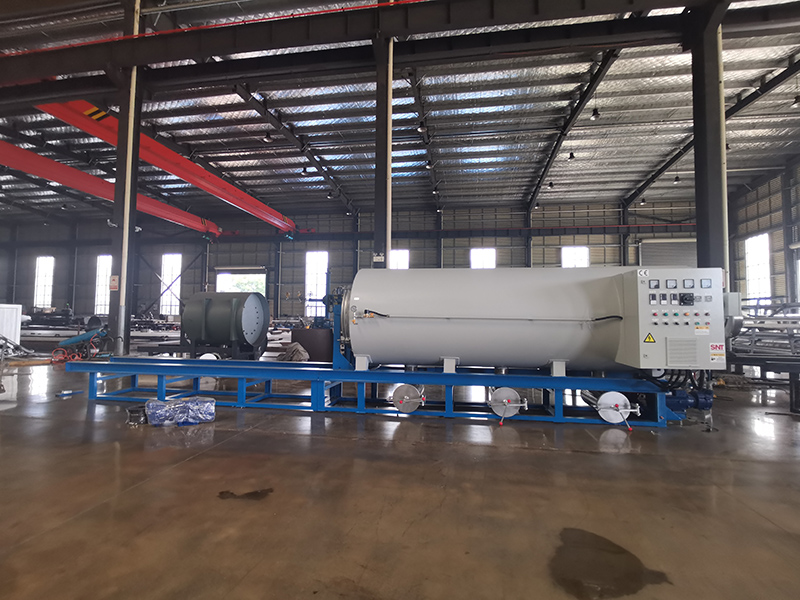
Screw Vacuum Cleaning Furnace Liner Material: How to Pick the Right One
The liner inside a screw vacuum cleaning furnace takes the hardest beating of any component. It endures repeated thermal cycling from ambient to 450°C, vacuum pressure swings, and direct contact with decomposed polymers, carbon residue, and corrosive off-gases. Get the material wrong and you are looking at premature wall thinning, pitting, warping, or catastrophic failure mid-cycle. The liner is not a detail — it is the backbone of the entire machine.
Why Liner Material Makes or Breaks Your Furnace
Most buyers focus on vacuum pump specs or temperature controller accuracy. Those matter, but the liner material determines how long the furnace actually lasts under real operating conditions. A furnace running at 400°C in a vacuum environment with intermittent air backfill creates a uniquely aggressive chemical climate. Polymer residues decompose into acidic compounds that attack metal surfaces. Every heating and cooling cycle stresses the liner mechanically. Over hundreds of cycles, the wrong material will degrade visibly — scaling, flaking, or developing pinhole leaks that ruin vacuum integrity.
The cost of a liner replacement is not just the part. It means downtime, lost production, and in some cases — especially in semiconductor or pharmaceutical applications — a full re-qualification of the cleaning process. Choosing correctly upfront saves far more than it costs.
Stainless Steel Grades: The Real Differences That Matter
316L Is the Clear Winner for Most Applications
If you are cleaning screws, filter cores, or spinneret plates in a vacuum furnace, 316L stainless steel is the material you want. The molybdenum content in 316L gives it significantly better resistance to pitting and crevice corrosion than 304, especially in the acidic environments created by decomposed polymers. At temperatures above 350°C, that difference becomes critical.
Real-world feedback from heavy users confirms this. Operators running 6-hour daily cycles for months report that 316L liners show zero signs of oxidation or scaling, while thinner 304 liners develop visible discoloration and surface degradation within weeks. The 2mm wall thickness commonly used in 316L liners adds structural rigidity that resists warping during rapid temperature changes — something a thinner 304 wall simply cannot handle.
304 Stainless Steel: Acceptable Only for Low-Temperature Work
304 works fine if your cleaning process never exceeds 300°C and you are not dealing with aggressive polymers like PVC or fluorinated materials. For general-purpose screw cleaning in the polyester or nylon range, 304 can hold up. But push the temperature higher or introduce chlorine-containing feedstocks, and 304 will pit and corrode noticeably faster. It is the budget option, not the smart option.
Carbon Steel: Do Not Even Consider It
Carbon steel liners exist in some low-cost furnaces. They are a mistake. At elevated temperatures in a vacuum environment, carbon steel oxidizes rapidly. The oxide layer flakes off, exposing fresh metal to further attack. Within a few dozen cycles, you will see wall thinning and eventually perforation. No coating or surface treatment fully solves this problem at 400°C. Avoid carbon steel liners entirely for any vacuum cleaning application above 250°C.
Ceramic and Enamel Coated Liners: When They Make Sense
Ceramic Glaze Coatings for Anti-Stick Performance
Some furnaces use a ceramic glaze or ceramic urethane coating on the inner wall. The advantage is obvious — decomposed polymer residue does not stick as aggressively to a smooth ceramic surface as it does to bare metal. This means faster cleaning cycles and less manual scraping between runs. For operations where turnaround time matters more than upfront cost, a ceramic-coated liner can reduce downtime by 20 to 30 percent.
The trade-off is durability. Ceramic coatings can crack under thermal shock. If your process involves rapid heating from room temperature to 400°C in under 15 minutes, the coating may develop micro-cracks that propagate over time. Once cracked, the coating loses its anti-stick benefit and can actually trap residue in the fissures.
Enamel Liners: The Heavy-Duty Middle Ground
Enamel-coated liners combine the corrosion resistance of glass-fused steel with better thermal shock tolerance than pure ceramic coatings. The enamel fuses to the steel substrate during manufacturing, creating a chemically inert surface that resists acidic condensate. For furnaces processing PVC, fluoropolymers, or other chlorine-releasing materials, enamel liners outperform bare stainless steel significantly.
However, enamel is brittle. Mechanical impact — like dropping a heavy screw into the chamber — can chip the surface. A chipped enamel spot becomes a corrosion initiation point. If your operation involves rough handling of parts, enamel may not be the best choice despite its chemical resistance.
High-Temperature Alloys and Exotic Materials
For extreme applications — cleaning PEEK screws, processing materials above 420°C, or running continuous high-temperature cycles — standard stainless steel and ceramic coatings are not enough. Some furnaces use Inconel or other nickel-based alloys for the hottest zones. These materials maintain strength and resist oxidation at temperatures where 316L starts to soften.
The downside is cost. Nickel alloys can be three to five times more expensive than 316L per kilogram. For most screw and filter cleaning applications, 316L with a 2mm wall thickness is more than sufficient. Exotic alloys only make sense when your process genuinely demands temperatures above 450°C or involves highly corrosive feedstocks that would destroy any other material within weeks.
Practical Selection Criteria Based on Your Application
Match the Material to Your Polymer Type
Polyester and nylon residues decompose into relatively mild organic acids. 316L handles these without issue. PVC and fluoropolymers release hydrochloric and hydrofluoric acid during decomposition — these will attack 304 and even 316L over time. For these materials, go with enamel-coated or ceramic-lined 316L. For ultra-high-temperature polymers like PEEK, consider nickel alloy liners in the hottest zones.
Wall Thickness Matters as Much as Material Grade
A 1mm 316L liner at 400°C will warp. A 2mm 316L liner will not. The extra millimeter of metal absorbs thermal stress and maintains dimensional stability across hundreds of heat cycles. When comparing furnaces, always ask about liner wall thickness — not just the alloy grade. A thick 304 wall can outperform a thin 316L wall in terms of structural longevity, even if it corrodes faster chemically.
Consider Your Cleaning Frequency and Cycle Time
If you run 10+ cycles per day with rapid heating, thermal fatigue becomes the dominant failure mode. In this case, prioritize materials with high thermal shock resistance — thick 316L or enamel-coated steel. If you run 2 to 3 cycles per day with slow ramps, corrosion resistance matters more, and a ceramic-coated liner could extend your service intervals significantly.
What to Check Before You Commit
Ask the manufacturer for the exact liner alloy specification, wall thickness, and surface treatment method. Request documentation of vacuum leak testing after thermal cycling — a liner that passes at room temperature can fail miserably after 50 cycles at 400°C. If possible, ask for references from users running similar polymer types at comparable temperatures. The liner material is not a spec sheet number. It is the difference between a furnace that runs for eight years and one that needs replacement in eighteen months.